Life and Death on the Mara River
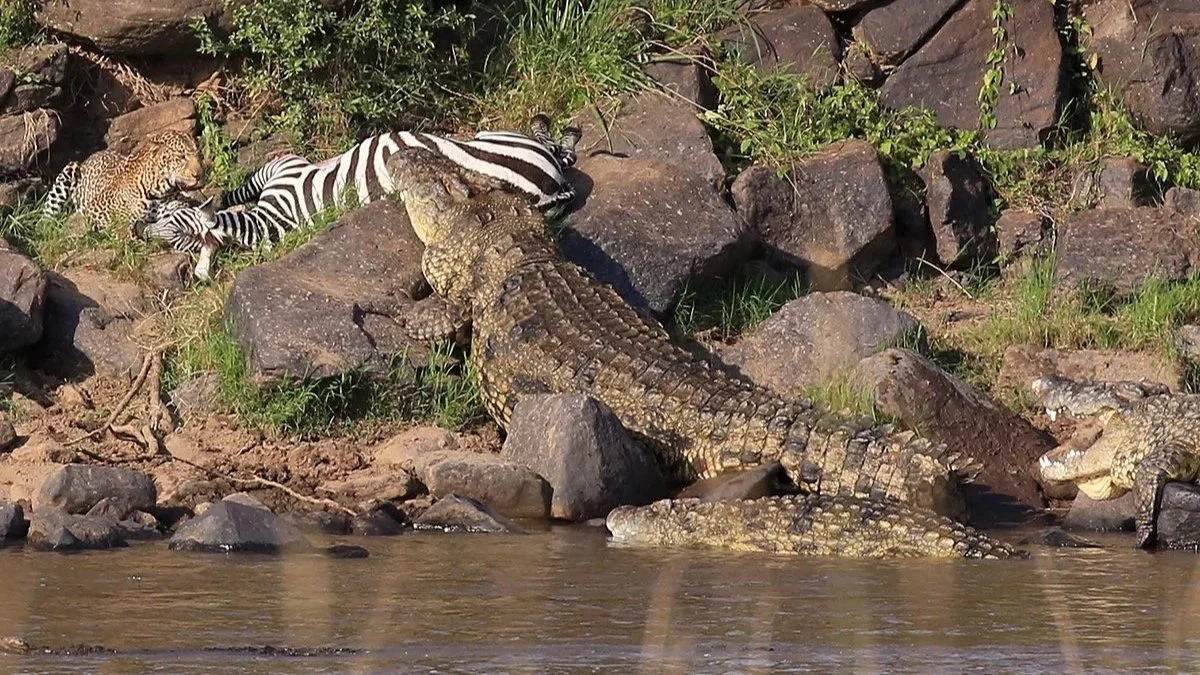
LEOPARD, ZEBRA and NILE CROCODILE
Our morning drive was most successful. We traversed the acacia-dotted savanna of the Mara Triangle and came across a herd of elephants, Maasai giraffes, Cape buffalo, zebras, hippos, waterbuck, topi, impala, spotted hyenas, a male lion, and numerous birds. August is peak wildebeest migration in Kenya’s Mara, and we had seen sizable herds feeding on the short grasses. We, like other visitors, were hoping to see a major river crossing. This event was what Kenya was most noted for—the migrating herds of zebra and wildebeest crossing one of the main rivers in the Mara reserve.
On the edge of the river bank, when numbers build into the thousands, and after many stop and starts, one brave soul decides to take the plunge and the others follow! It is truly one of the greatest wildlife spectacles to witness. The crossing is fraught with peril, as they all rush forward in a jumble, hastily make their way across the narrow river. The current can make the short journey longer than it looks. In the midst of the river, the zebras and wildebeests must out-maneuver a congregation of patiently waiting Nile crocodiles. It is certainly a matter of life and death. Their reward - the grass is always greener on the other side and they get to keep all their limbs intact.
I suggested to my guests that since that we had a wonderful morning, it might be a good idea to just wait at one of the river crossing points and see if anything unfolds. It would require a great deal of patience, but as one knows when on safari, nothing is guaranteed and one never knows what might show up. Everyone was keen. Settle in we did. It was relatively quiet. We were the only vehicle there, along with five zebras on the far side. We could pick out a couple of crocodiles near the boulders that protruded out of the water, and spotted a yellow-billed stork patrolling the waters edge. Conversation flowed as we waited in the hope that wildebeests or more zebras would show up. A glass of wine was offered and accepted. A couple of hours flew by.
Then, after much hesitation, a mother zebra and her calf ventured gingerly waters edge and began to work their way across the river. This did not go unnoticed by the crocodiles. Several crocs slowly moved towards the zebras hoping to cut them off before they reached the side we were on. One zeroed-in on the mare, and another on the calf. Both zebras found themselves trapped. There was a flash of water, startling us and the baby zebra. The calf managed to jump and swim out of harms way and turn back to the river bank. From there she watched as her mother somehow managed to break the grip of the other crocodile’s jaws and she turned back to reach the safety of the bank while the crocodiles followed. She walked beyond some large boulders, and we could see that her hind leg was broken. She collapsed from exhaustion and, no doubt, pain. Suddenly, out from the thicket at the top of the bank, a leopard appeared and clamped its strong jaws around the zebras windpipe to suffocate it. Meanwhile the zebra calf was witness to all of this. The first crocodile, one of the biggest in the river, tried to inch its way over the huge boulders to get closer to the carcass. Luckily for the leopard, the crocodile was just too large to climb over the massive boulder to claim his meal. The leopard would keep the prize instead.
We were the only people there to witness this extraordinary event unfold. We had hoped that patience would pay off for us and it did… just not in the way we first thought.
In all my years of leading safaris I’ve found that nature will always surprise us, if we just take the time to orient ourselves to the natural rhythms of our surroundings.